AI and other frontier technologies will change how work is done. For leaders, this is not only a technology topic. It is a business and leadership topic. MU’s Leadership Navigator Report 2026* identified AI and new technology adoption as the most important, shared challenge and opportunity facing leaders. It is not a short-term trend. It is a structural change that leaders must manage over time. As a result, it represents a new requirement on all leaders.
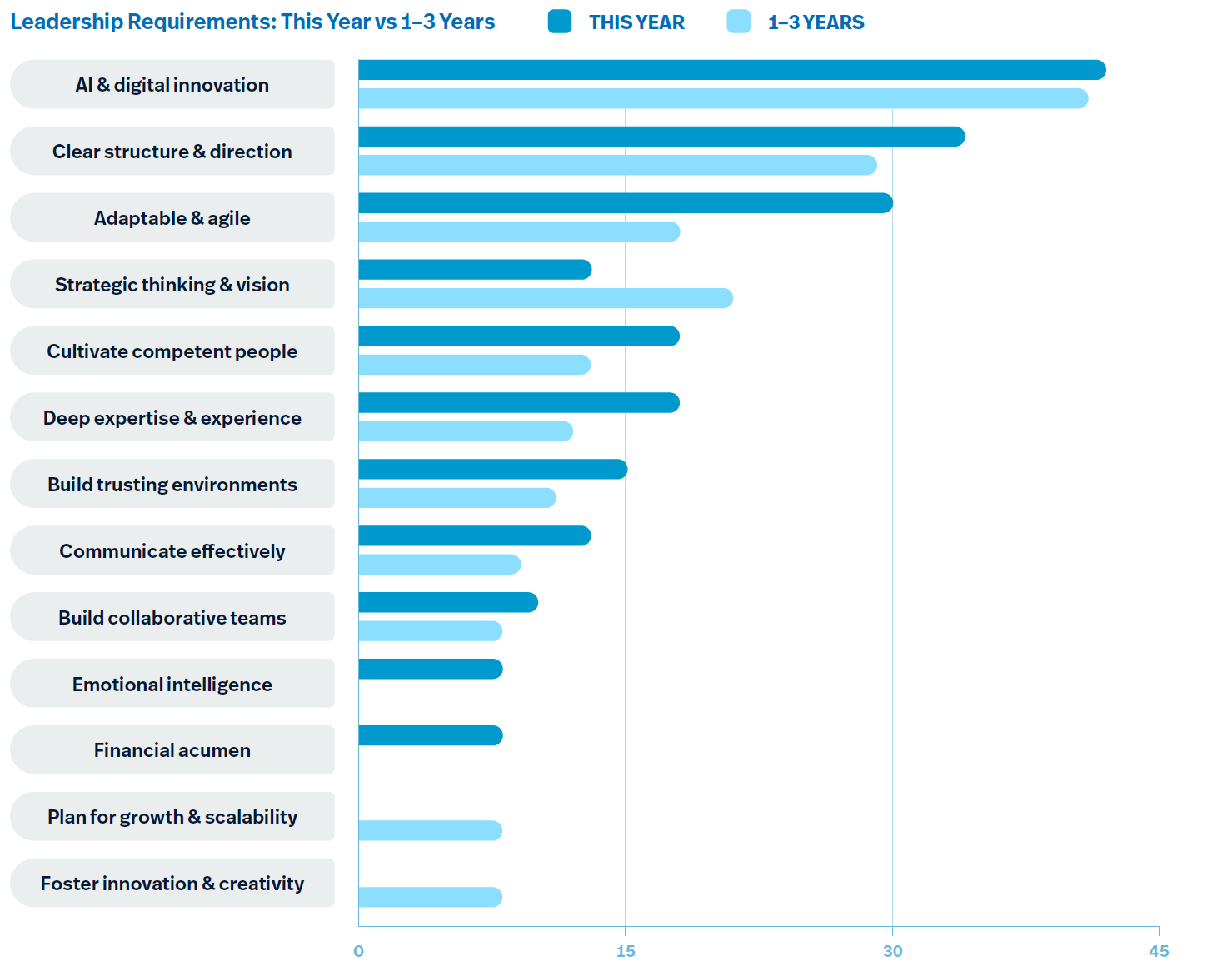
*Source: MU Leadership Navigator 2026 “Leadership Through Uncertain Times
Leadership in the AI era will always be context specific. Even ubiquitous leadership challenges and opportunities — such as AI adoption — require a tailored response. There is no generic ‘AI capability’ that will help leaders achieve results. But, as a leader, there are some important questions you will need to address so your team is well placed to succeed:
- How can I unlock the opportunities AI creates for our organisation?
- What risks do AI and other frontier technologies create for us — and how will we safely navigate them?
What do we Mean by AI?
Based on the EU AI Act, AI can be understood as a machine-based system that, with varying degrees of autonomy, uses the information it receives to generate outputs such as predictions, recommendations, decisions or content. In practice, for most leaders, the most useful focus is on today’s AI tools, especially machine learning and generative AI. Technology that is available now, or soon will be, that:
- Processes large amounts of data
- Finds patterns
- Supports predictions or decisions
- Generates content such as text, images, or summaries
- Does not need to be programmed step by step for every scenario.
Choosing the right definition for AI discussions is important because leaders need to define the terms of reference for their team. Otherwise, too much discussion about AI in organisations can get caught between hype and fear, and that will not help focused decision-making or employee adoption. Leaders do not need either science fiction ideas or an avoidance mindset in their teams. Too much or too little anxiety increases the risk. We need our teams to have a clear and practical view of what AI can do, what it cannot do, and how it can be used responsibly. This is especially important as more agentic (autonomous) AI is introduced into workflows, creating new opportunities, new risks and changing roles for employees.
The Opportunity: Where can AI Create Value for Your Organisation?
AI based opportunities usually fall into four areas:
-
Innovation: Creating new business models
-
Effectiveness: Improving products, services and customer relationships
-
Efficiency: Saving time, money and waste
-
Augmentation: Releasing people’s time and focus to do higher-value work.
1. Innovation: Can AI Enable Your new Business Model?
For some organisations, AI can support people in finding and developing entirely new products, services, or business models. Digital-native businesses often use technology to redesign how an industry works. Think Uber. But traditional analogue born organisations can also use AI to create new offers or enter new markets.
To do this well, leaders should ask:
- Do we have useful data that others do not have?
- Do we have the right people and skills? Can we attract them?
- Can our leaders guide this change successfully?
- How can we speed up? (What kind of organisation can decide and implement effectively
and more quickly?)
Even if AI does not create a completely new business model, this thinking can still reveal valuable use cases and growth opportunities.
What Major new Advantages Could you Give to Current or Future Customers?
Case Example
One of the world’s largest banks used AI machine learning to create a new lending product that gave real-time decisions while customers were still completing their loan application form. Better feedback during the process reduced unnecessary rejection, improved customer experience and encouraged more applicants to complete — creating growth, not just efficiency. It also opened a whole new market; people concerned about getting a rejected loan and the resultant bad credit reference no longer needed to take that risk. The loan decision was possible without a credit check. A new approach to loan approvals created a new market.
2. Effectiveness: Improving products or services and customer experience
For many organisations, the best AI opportunities are practical. AI can help improve customer service, product quality, and response
times. The right starting point is not the technology itself. It is the customer problem. Leaders should ask:
- What is frustrating our customers?
- Where are service levels too slow or inconsistent?
- Which business bottleneck matters most?
What Customer Problem is Most Important to Solve?
Case Example
A leading global telecommunications firm wanted to differentiate itself through customer service. Its challenge was to reduce waiting times and resolve support issues faster. By utilising generative AI to deal with simpler, more repetitive customer interactions resolution times dropped, customer satisfaction increased, and the cost of customer service was reduced. Similar models has since been implemented by many firms.
In many cases, step-by-step technology-based improvement works better than large transformation programmes. Small, focused AI solutions are often easier to test, govern, and improve. The simplest functional AI solution that can be deployed, governed, and iterated quickly is the one to choose.
3. Efficiency: Saving Time, Cost, and Waste
AI integration can also create value by improving efficiency. For example, it can increase processing speed and reduce processing cost:
- Reduce downtime
- Improve planning
- Automate repetitive tasks
- Support predictive maintenance
- Improve consistency in routine processes.
Efficiency use cases are often easier to justify because the value is easier to measure. Leaders should ask:
- Where is wasted resource or cost highest? (So where should we start our efficiency focus?)
- Which processes are repetitive and time-consuming?
- Where could better prediction improve performance?
Where is Your Biggest Financial Opportunity to Increase Efficiency?
Case Example
One global manufacturer used AI machine learning to support predictive maintenance by identifying warning signs before pumping equipment failed. By analysing machinery data, the company could intervene earlier, reduce disruption and cut maintenance costs. AI does not sleep in such a context, it scales efficiencies at a commercially viable cost. In the right setting, AI can remove manual work, improve consistency and increase the performance of traditional systems and machines.
4. Augmentation: Helping People do Higher-Value Work
Another important opportunity is augmentation. This means using AI to support people, not simply replace their tasks. Effective AI augmentation increases productivity — it delivers more without increasing headcount. To achieve this, AI integration can help employees in:
- Reducing repetitive work
- Summarising information
- Supporting analysis
- Improving preparation and focus
- Freeing time for judgement, creativity, and customer contact.
This may become one of the most valuable long-term uses of AI. But it only works if organisations redesign work carefully and help people learn how to use AI well.
Which of your team should spend more time on higher value work? How will you help them adapt?
Case Example
A leading global consultancy found that by automating elements of scheduling, administration, invoicing and customer collections, its consultants were freed to spend more time on client work. In many white-collar settings, that is where the true value lies: Not simply in doing the same work more cheaply, but in enabling people to focus on work of higher value. Used well, AI can elevate human contribution.
AI Adoption Checklist: The Strongest AI Opportunities Have Clear Answers to These Questions:
- Why are we introducing AI?
- Well, aligned to business strategy
- Meeting a clearly defined need or opportunity.
- What value are we trying to create?
- Commercially viable
- Short term and sustainable value.
- What is the ambition level?
- Focused on narrow, repetitive or routine tasks
- Supported by sufficiently well-curated and accurate data.
- What are the consequences?
- Manageable in terms of risk and oversight
- Realistic to implement; analogous to proven use cases elsewhere
- Built on established machine learning techniques, not hype.
To realise these opportunities organisations will need to develop from ‘project based’ change to a more agile workforce and culture — where change is the status quo, rather than an occasional management led process. You will need leaders able to make the right judgments for your context and teams that are ready to change. These topics are in sharp focus in our other articles in this “Future of Work” series. But first, before focusing on being able to adapt their organisations effectively, leaders must be able to understand and manage AI-associated risks.
The AI risks: Where can AI Create Problems for Your Organisation?
AI implementation and integration can create real value. But it also introduces real risk. Responsible adoption depends on understanding both. The key considerations for leaders are:
- Data
- Trust
- Effect on people
- Unintended consequences
- Commercial
- Geopolitical and regulatory
1. Data Hungry, Data Sensitive, and Context Dependent
AI depends on sufficient relevant data. If the data is poor, old, biased, incomplete, or badly structured, the output will also be poor.
AI systems are also context dependent. A system trained in one domain does not automatically transfer well to another, even if it may appear to. And when the real-world changes, the model stops performing reliably. If training data reflects old patterns or biases, the output scales those errors and biases. If conditions change, performance will decline.
Leaders should remember:
- Data quality matters
- Context matters
- Effective human judgement and oversight is needed.
Good data engineering and AI technical expertise are critical.
2. Opaque, Fallible and Hard to Trust
AI systems make mistakes. Some arise from poor data. Some from technical limits. Some from how people interact with the system. But what makes these mistakes especially difficult to manage is that the decision-making process will have opaque elements. This creates a leadership challenge. If people do not understand why an AI system gave an answer, trust may be weak. If something goes wrong, accountability may also become unclear. Who is responsible? The user? The vendor? The leader? The organisation? This matters even more in high-stakes areas such as:
- Hiring
- Health
- Financial services
- Legal decisions
And what happens if the AI Agent acts unpredictably, and in a way that may damage people, business or society? The AI Security Institute (AISI) is a research organisation within the UK government’s Department for Science, Innovation and Technology. It has reported several incidents of AI Agents performing “novel, potentially deceptive behaviours to an extent and severity we did not anticipate” (AISI, 2026)
To secure trust, and reduce risk of AI created damage that may appear short term or much later, leaders need to ensure:
- Simple governance
- Clear policies for acceptable use
- Effective training and communication
- Risk management and conformity tests per system
- Well documented use cases; registered and controlled
- Clear accountability
- Reliable and appropriate human oversight
- Who notices when something isn’t right?
- Who has authority to challenge or override?
- How is that judgement exercised?
- How do we know it actually happened?
- AI Governance as a leadership capability
- Sufficient AI and data protection regulatory knowledge
- Skills to redesign workflows and where human and machine interact differently
- Understanding how decisions move through an organisation
- Who decides? Who challenges?
- Where do decisions escalate? Who remains accountable once AI becomes part of the workflow?
3. Faster, but Dumber?
AI can make people faster. But if it is used badly, it may also reduce learning, critical thinking, and judgement. Human understanding suffers. This is a serious long-term risk. If people rely too much on AI, they may become less mentally engaged. Errors may be missed more easily. Capability may weaken over time. ‘Cognitive surrender’ can set in — just think about the effect google maps has had on our knowledge of, and ability to, navigate without our phone. And then multiply this manifold across a hug range of tasks and skills in your workplace. ‘AI Slop’ is produced internally in papers and reports, or worse still for customers. Employees do not really understand what they are doing and skills are lost.
Recent studies about AI adoption in professional services point to this difficult challenge. Consultants using AI often complete more work in less time. But their understanding of client needs and the depth of their thinking was also reduced. The business news is already inundated with embarrassing apologies from consulting firms, caught issuing research or insights that are inaccurate or non-sensical — AI Slop is a real risk.
What is the value of AI efficiency if people’s capability declines?
Leaders should therefore look at more than productivity (time saved, quality improvement, etc.) They should also track:
- Human understanding
- Employee confidence
- Error rates
- Human override rates
- Learning and development need analysis and delivery.
The goal is not only faster work. It is higher and more sustainable performance. Effective ongoing piloting and longitudinal follow-up is essential. As is clearly describing the expected new human-AI workflow interface — and securing appropriate governance and control.
4. Unintended Consequences
AI can produce outcomes that look good on paper but create other problems later. If organisations automate too fast or too far, or in the wrong places, they may create customer frustration, social backlash, weakened talent pipelines, lower engagement and even reputational harm.
These second-order consequences of AI adoption matter. So do associated stakeholders concerns about privacy, cyber vulnerability, resilience, climate impact and social inequality linked to differences in AI literacy. Which AI use cases may lead to unintended consequences in your context? That is why leaders should not only ask, “Can we automate this?” They should also ask, “Should we?” and “What might happen next?”
5. Spiraling Costs and Uncertain Returns
AI investment can be expensive. Some organisations move too early, spend too much, or pursue weak use cases. Others move too slowly and lose advantage. It is easy to underestimate how expensive AI can become in practice. Token costs, data engineering, testing, model monitoring, computing power, integration and governance can all scale faster than expected.
Without Permanent Employees at a Junior Level, who Will be Your Successors? What will Customers Think of Your Firm’s Talent Practices?
Case Example
In contrast to the earlier case where a large technology firm improved customer service using AI, one large ‘born digital’ financial institution replaced its customer care handlers with AI, only to find that customers still wanted access to a real person. Human support had to be reintroduced. But now it sat behind a less stable, more fragmented ‘gig’ (freelance) employment model. The savings were less than expected, customer experience deteriorated, and the fix did not result in people being reemployed with stable and secure employment prospects.
The vast investments made into AI development will need to be repaid by customers — your organisation is one of them. One global CEO reports that his team is burning through a month’s worth of budgeted tokens every three days. That is a tenfold overspend. And this is just the beginning. Returns are often uncertain beyond a limited set of proven applications, but the costs will increase. Leaders therefore need to be far more commercially disciplined than ‘the hype’ may encourage. Indeed, many early and high adopters of AI are already rationing tokens. Leaders need to ensure use case are tested carefully and focus on where AI creates real business value. Useful questions include:
- What is the expected value?
- How will we measure results?
- What will this cost to build and maintain?
- Do we have the data and people needed to succeed?
- How will we control focus in implementation?
- What token and other costs will we incur, and how may they increase with full adoption?
6. Geopolitical and Regulatory Hazards
The final layer of risks to be managed originate outside your organisation — in politics, society and community. Questions about AI sovereignty, the required infrastructure, data localisation, regulatory impact, national security and critical industry exposure are becoming more important.
Leaders do not need to be legal experts, but they do need enough understanding to ask the right questions and ensure proper oversight. Board attention is also important, especially where AI use affects customers, employees, or public trust. Do you have, or can you develop:
- Leaders with sufficient regulatory knowledge (or access to it)
- Leadership curiosity toward macro factors such as broader technology development and different geopolitical scenarios
- Effective Board oversight.
What do the Opportunities and Risks Mean for Leaders?
AI is changing work, decision-making, customer expectations, and competitive dynamics.
- The main question is where can AI create practical value without creating unmanaged risk?
- The second inevitable question is — how will it change work?
The leadership challenge is not only technical adoption, but responsible business integration. Strong AI adoption depends on robust governance, sound data practices and effective people leadership. These factors stand out above others:
- First, data is an asset. Much of the effort, cost and time in AI adoption sits not in the model, but in data collection and engineering
- Second, people’s adoption is the real test. AI implementation requires changes in employee behaviour
- Third, leaders at all levels must be able to lead in the AI era. Increased complexity and pace of change, as well as the need to understand new technologies, place new requirements on leaders.
Algorithms are often favored because they offer speed, scale and consistency. Humans are often preferred because they offer accountability, transparency, empathy and the ability to consider individual circumstances. The future of successful work will be how to get both to work in harmony and design organisations that can achieve this.
For leaders, the AI Era means to be ambidextrous: running today’s business with one hand while developing future ways of working with the other.
To find out more, read our next article:
What skills and knowledge do you need as a leader in the AI era - and how will you identify, select and develop them?